M.Voc in Radiology & Medical Imaging Technology
“See Beyond the Image. Learn the Science. Build the Skills.”
University-Led Education. Practical Training. Professional Skill Development.
Explore advanced vocational education in Radiology & Medical Imaging Technology through a learning approach that connects academic knowledge with practical understanding, diagnostic imaging technology, professional competencies, patient care awareness, and healthcare workplace skills.
At Lohiya MediTech, education goes beyond textbooks. We emphasize the connection between university-led academic learning, practical training, technical skill development, and professional growth to help learners understand the evolving world of medical imaging and diagnostic healthcare.
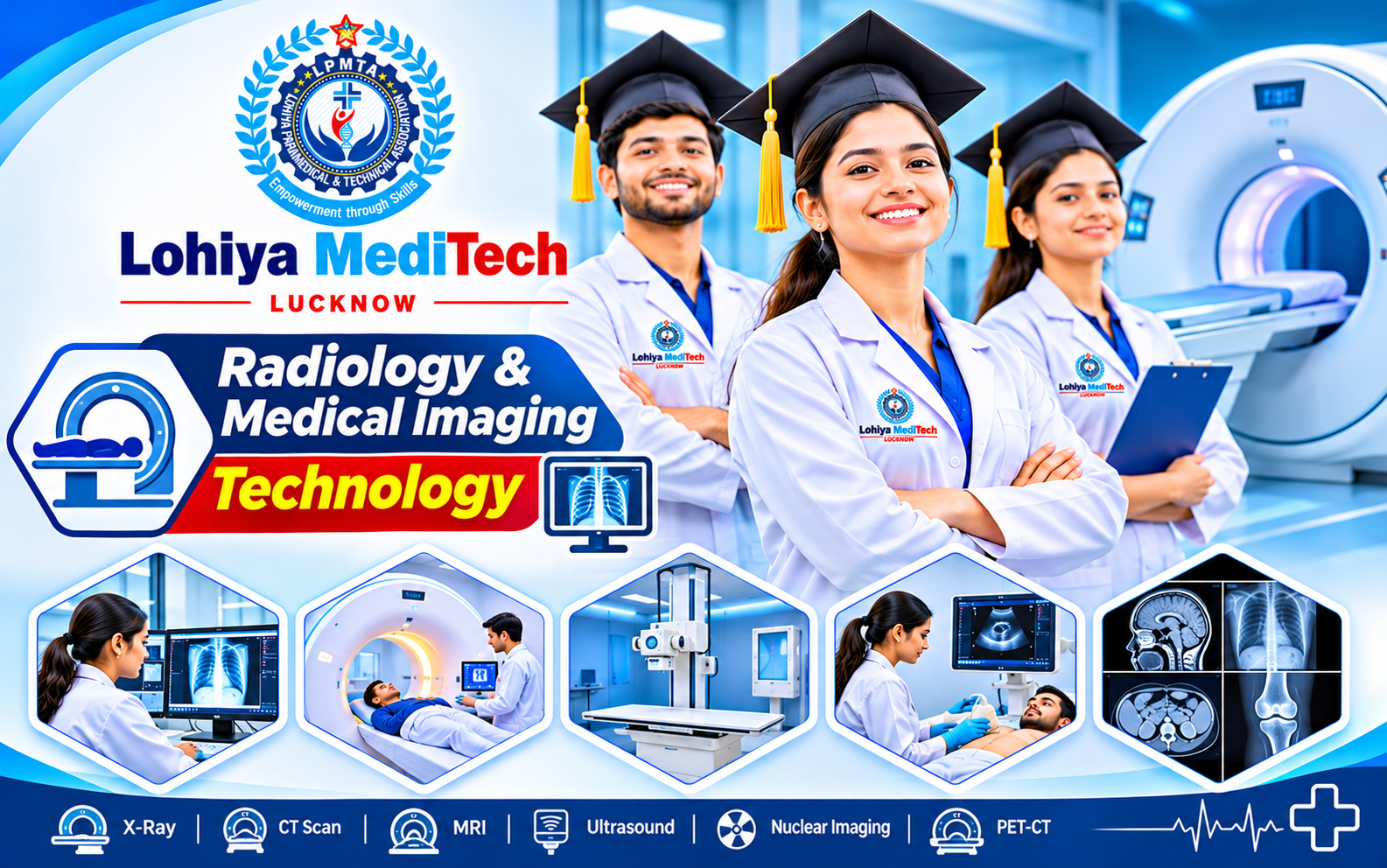
Advancing Knowledge in the World of Medical Imaging
“Understand the Science Behind Imaging. Develop Skills for the Future of Healthcare.”
Postgraduate Vocational Pathway in Medical Imaging
M.Voc in Radiology & Medical Imaging Technology is a postgraduate vocational education pathway offered at Lohiya MediTech in association with a UGC-recognised awarding university, focused on advanced learning, technical competency, professional understanding, and the evolving role of imaging technology in healthcare.
Medical imaging professionals play a vital supporting role in modern healthcare through structured education, competency development, radiation and patient safety awareness, and ethical professional responsibility—always operating within authorized scopes of practice.
How Medical Imaging Contributes to Healthcare
- Supporting clinical diagnosis
- Understanding internal anatomy
- Detecting and evaluating medical conditions
- Supporting clinical decision-making
- Monitoring patient conditions
- Guiding appropriate healthcare management
- Advancing modern diagnostic services
Education Beyond Theory. Learning Beyond the Classroom.
“Academic knowledge gives you understanding. Practical learning develops your skills. Professional education prepares you for the responsibilities of healthcare.”
Beyond Classroom Theory
Healthcare education should not remain limited to classroom theory. Learners need a meaningful understanding of technology, practical concepts, patient care responsibilities, workplace discipline, safety, communication, and professional conduct.
Lohiya MediTech serves as an educational platform focused on helping learners connect their academic qualifications with practical understanding and professional competencies for diagnostic imaging settings.
At Lohiya MediTech, We Emphasize
- Academic knowledge through university-led education
- Practical learning to strengthen theoretical concepts
- Technical understanding of medical imaging systems
- Professional competency development
- Patient-centred healthcare awareness
- Workplace-oriented learning
- Communication and teamwork
- Ethical and responsible professional practice
- Continuous skill enhancement
Three Pillars of Learning. One Vision for Professional Growth.
“Learn the Science. Understand the Technology. Develop the Skills.”
University-Led Education
“Build Your Knowledge. Strengthen Your Academic Foundation.”
Structured university-led education serves as the academic foundation of the programme, building core understanding of radiology and medical imaging sciences.
- Academic curriculum
- Imaging science fundamentals
- Human anatomy and physiology
- Medical imaging principles
- Diagnostic imaging concepts
- Academic progression
- Structured postgraduate vocational learning
Practical Training
“Learning Becomes Stronger When Knowledge Meets Practice.”
Practical learning connects academic concepts with professional healthcare environments. Where included in the programme, learning opportunities are conducted under authorized, qualified supervision consistent with patient safety and applicable requirements:
- Demonstrations of imaging equipment
- Familiarization with imaging systems
- Practical learning activities
- Understanding imaging department workflow
- Patient positioning concepts
- Image quality awareness
- Equipment safety awareness
- Imaging procedure observation
- Practical competency development
- Supervised learning in appropriate settings
Professional Skill Development
“Develop the Skills. Build Confidence. Prepare for Professional Responsibilities.”
Healthcare professionals need technical understanding alongside responsible conduct, clear communication, teamwork, and professional awareness.
- Professional communication
- Patient interaction
- Teamwork
- Technical awareness
- Workplace discipline
- Patient dignity and privacy
- Safety consciousness
- Attention to detail
- Documentation awareness
- Professional ethics
- Time management
- Adaptability
- Continuous learning
The Lohiya MediTech Advantage
“We Connect Education with Skills. We Connect Learning with the Healthcare Profession.”
UNIVERSITY-LED EDUCATION
Academic learning within the framework of the awarding university's curriculum, academic requirements, and applicable policies.
PRACTICAL LEARNING APPROACH
Connecting theoretical concepts with practical demonstrations, technical learning, supervised exposure, and competency-oriented educational activities.
IMAGING TECHNOLOGY ORIENTATION
Learning about modern diagnostic imaging systems, imaging sciences, equipment concepts, and evolving healthcare technology.
PROFESSIONAL SKILL DEVELOPMENT
Developing communication, teamwork, discipline, patient care awareness, and professional responsibility.
HEALTHCARE INDUSTRY PERSPECTIVE
Understanding the professional environment, workflow, responsibilities, and expectations of diagnostic imaging departments.
CAREER-FOCUSED LEARNING
Encouraging students to build relevant competencies, understand career pathways, and continue professional development.
STUDENT-CENTRED LEARNING
Supporting learners through educational guidance, learning support, competency development, and professional awareness.
FUTURE-READY EDUCATION
Encouraging adaptability, technology awareness, continuous learning, and understanding of changing healthcare practices.
Bridging the Gap Between Academic Education and Healthcare Industry Skills
“From Classroom Knowledge to Imaging Technology. From Education to Professional Competency.”
The Gap Students Need to Understand
Academic education provides theoretical knowledge, but healthcare workplaces also require practical understanding, professional discipline, patient interaction, technical awareness, teamwork, safety consciousness, and adaptability to evolving technologies.
- Academic knowledge versus practical understanding
- Textbook concepts versus workplace application
- Technology knowledge versus equipment familiarization
- Learning theory versus professional responsibilities
- Qualification versus competency development
- Classroom learning versus healthcare workplace awareness
Lohiya MediTech's Learning Approach
Our integrated learning philosophy connects academic foundations with technical familiarity and workplace readiness across progressive stages.
“Education teaches you the principles. Practical learning connects those principles with the real world. Skills help you prepare for the responsibilities of your profession.”
Explore the Science of Seeing Inside the Human Body
“Technology That Reveals. Knowledge That Interprets. Healthcare That Advances.”
Different imaging modalities support diagnostic information gathering in healthcare. Educational learning introduces principles, equipment concepts, and safety awareness without implying independent medical diagnosis or interpretation beyond authorized scope of practice.
X-RAY IMAGING
An introduction to radiographic imaging principles and the role of X-ray technology in diagnostic examinations.
COMPUTED TOMOGRAPHY – CT
An introduction to cross-sectional imaging and the role of CT technology in medical diagnostic applications.
MAGNETIC RESONANCE IMAGING – MRI
An introduction to MRI principles and the role of magnetic resonance technology in medical imaging.
ULTRASOUND IMAGING
An introduction to ultrasound technology and its applications in diagnostic imaging.
SPECIALIZED IMAGING
An introduction to advanced and specialized imaging applications, as applicable to the curriculum.
SCOPE & SAFETY BOUNDARIES
Educational orientation to imaging modalities and technical workflows within authorized clinical and regulatory boundaries.
Develop Knowledge Across Modern Imaging Sciences
“Learn the Principles. Understand the Modalities. Strengthen Your Competencies.”
Advanced Radiographic Imaging
Core concepts in diagnostic radiography.
Imaging Physics
Physical principles underlying medical imaging.
Human Anatomy & Physiology
Anatomical structures and physiological systems.
Advanced CT Imaging Concepts
Cross-sectional scanning fundamentals.
MRI Principles & Applications
Magnetic resonance imaging concepts and uses.
Ultrasound Imaging Concepts
Acoustic imaging principles and applications.
Medical Imaging Equipment & Instrumentation
Overview of imaging systems and hardware.
Imaging Techniques & Protocol Awareness
Standardized imaging procedures and protocols.
Image Quality & Processing
Factors affecting clarity and image processing.
Radiation Safety & Protection
Protective measures and safety principles.
Patient Care in Imaging
Supportive care during diagnostic imaging.
Imaging Department Workflow
Coordination and operational flow in imaging units.
Medical Ethics & Professional Conduct
Ethical standards and professional accountability.
Quality Assurance in Imaging
Maintaining consistent quality and safety standards.
Research Methodology
Structured inquiry and evidence-based learning.
Healthcare Technology Applications
Modern digital tools in diagnostic healthcare.
Knowledge in Action. Skills in Development.
“Practical Learning Is the Connection Between Knowing and Doing.”
Connecting Theory, Equipment & Patient Care
Practical training helps learners understand the relationship between theory, equipment, procedures, patient care, and professional responsibilities.
Clinical activities involving patients, imaging equipment, or radiation must be conducted only under authorized, appropriately qualified supervision and according to applicable safety requirements.
Competency-Oriented Learning Activities
- Imaging equipment familiarization
- Understanding radiographic systems
- Imaging department orientation
- Patient positioning principles
- Imaging workflow awareness
- Patient preparation concepts
- Image quality awareness
- Safety protocols
- Equipment operation concepts
- Technical demonstrations
- Supervised practical learning
- Professional observation
- Healthcare documentation
- Technical competency development
Technology Matters. Patient Care Matters More.
“Behind Every Image Is a Patient Who Deserves Care, Respect and Safety.”
The Human & Safety Dimension of Medical Imaging
Medical imaging is both a technology-driven and patient-centred profession. Compassionate, respectful, and safety-conscious conduct protects patients and supports high standards of care.
- Patient dignity
- Respectful communication
- Patient comfort
- Privacy and confidentiality
- Professional behaviour
- Patient identification awareness
- Infection prevention
- Radiation safety awareness
- Appropriate patient preparation
- Safe healthcare practices
- Team coordination
- Ethical responsibility
“A skilled healthcare professional understands technology. A responsible healthcare professional never forgets the patient behind it.”
Beyond the Classroom – Understanding Healthcare in Practice
“Experience the Learning Environment. Understand the Profession. Develop Your Perspective.”
Potential Learning Environments
Where applicable within the programme structure, learners may gain exposure to environments such as:
- Hospital imaging departments
- Diagnostic imaging centres
- Radiology departments
- Medical imaging facilities
- Healthcare institutions
- Imaging equipment environments
- Clinical learning settings
Value of Workplace Orientation
- Understanding departmental workflow
- Observing professional responsibilities
- Learning about patient care processes
- Understanding imaging department coordination
- Becoming familiar with healthcare protocols
- Learning professional communication
- Developing workplace awareness
Beyond Imaging Technology – Developing the Professional
“Your technical knowledge is your strength. Your professional attitude is your identity.”
| Professional Skill | Why It Matters |
|---|---|
| Communication | Helps support clear, respectful patient and team interaction |
| Teamwork | Encourages coordinated healthcare work |
| Patient Care | Builds awareness of patient comfort, dignity and needs |
| Safety Awareness | Reinforces responsible healthcare practices |
| Professional Discipline | Develops responsible work habits |
| Attention to Detail | Supports careful and accurate technical work |
| Time Management | Helps understand healthcare workflow and priorities |
| Adaptability | Encourages learning and adjusting to new technology |
| Ethical Conduct | Supports privacy, respect, and responsibility |
| Continuous Learning | Keeps knowledge and skills developing |
Explore Your Future in Medical Imaging
“Build Your Knowledge. Strengthen Your Skills. Explore Your Professional Potential.”
Potential career pathways in radiology and medical imaging technology depend on academic qualifications, relevant experience, practical competencies, recruitment requirements, employer criteria, and applicable regulatory requirements:
Radiology & Medical Imaging Technologist
Diagnostic imaging support in healthcare settings.
Medical Imaging Professional
Technical participation across imaging workflows.
Radiographic Imaging Technologist
Radiographic procedures under applicable protocols.
CT Imaging Technology Professional
Computed tomography imaging operations support.
MRI Technology Professional
Magnetic resonance imaging environment support.
Imaging Department Technical Professional
Departmental technical coordination and care.
Medical Imaging Equipment Support
Equipment readiness and technical coordination.
Diagnostic Imaging Operations
Supporting diagnostic centre and unit operations.
Healthcare Technical Services
Technical service roles across healthcare providers.
Imaging Quality & Safety Support
Assisting with safety and quality procedures.
Imaging Research Support
Supporting research and academic studies.
Healthcare Technology Services
Evolving healthcare technology support roles.
Take the Next Step in Your Educational Journey
“For Learners Who Want to Advance Their Knowledge and Strengthen Their Professional Skills.”
Who Should Explore M.Voc. in Radiology & Medical Imaging Technology?
- Graduates in Radiology & Medical Imaging Technology
- B.Voc. graduates in relevant healthcare specializations
- Graduates with relevant medical imaging qualifications
- Healthcare professionals seeking further academic development
- Candidates interested in diagnostic imaging technology
- Learners seeking advanced vocational education
- Individuals interested in technical and professional development in healthcare
Official Eligibility & Admission Norms
Eligibility criteria, accepted qualifications, programme duration, and admission requirements are governed strictly as prescribed by the UGC-recognised awarding university for the relevant academic session.
Please contact the Lohiya MediTech admission office for the latest official eligibility and admission details from the awarding university.
Your Journey from Education to Professional Development
BUILD ACADEMIC KNOWLEDGE
Develop an understanding of medical imaging sciences and relevant academic concepts.
UNDERSTAND THE TECHNOLOGY
Learn about imaging modalities, equipment, instrumentation, and technology applications.
DEVELOP PRACTICAL COMPETENCIES
Strengthen technical understanding through appropriate practical learning and supervised activities.
LEARN PATIENT CARE & SAFETY
Understand the importance of patient dignity, communication, safety, ethical conduct, and professional responsibilities.
ENHANCE PROFESSIONAL SKILLS
Develop teamwork, communication, discipline, confidence, problem-solving, and adaptability.
EXPLORE YOUR CAREER PATH
Understand potential career pathways, professional expectations, and opportunities for further learning.
Education That Connects Knowledge with Skills
“The Future Belongs to Learners Who Combine Knowledge with Competency.”
Connecting Academic Principles with Application
Vocational education complements academic learning by emphasizing the application of knowledge, competency development, and practical understanding in healthcare settings.
Key Dimensions of Vocational Learning
- Academic knowledge
- Practical learning
- Technical competency
- Workplace understanding
- Professional skill development
- Industry-oriented education
- Continuous learning
- Career awareness
Your Learning. Your Skills. Your Future.
“At Lohiya MediTech, we believe education should empower learners with knowledge, strengthen their skills, and inspire them to become responsible professionals.”
Academic Learning
Supporting structured postgraduate study.
Educational Guidance
Clear academic direction for students and parents.
Practical Skill Development
Connecting theory with hands-on concepts.
Professional Competency
Building technical and workplace readiness.
Healthcare Industry Awareness
Understanding diagnostic imaging environments.
Career Development
Supporting informed exploration of career paths.
Student Confidence
Encouraging self-assurance and capability.
Continuous Improvement
Growing steadily across academic stages.
Responsible Professional Conduct
Upholding safety, ethics, and patient respect.
Lifelong Learning
Adapting to evolving healthcare science.
Building a Stronger Connection Between Education and Healthcare
OUR VISION: “To create an educational environment where university-led learning, practical training, and professional skill development come together to empower learners for the evolving healthcare industry.”
Our Mission
- Promote university-led academic education.
- Strengthen practical and competency-oriented learning.
- Connect academic concepts with healthcare technology.
- Encourage professional skill development.
- Develop patient care and safety awareness.
- Support career-focused vocational education.
- Encourage adaptability and continuous learning.
- Bridge the gap between academic education and healthcare industry skills.
Perspectives That Shape Our Learning Culture
Primary Brand Tagline
“University Education. Practical Training. Professional Skills. One Path to a Stronger Future.”
Lohiya MediTech Positioning
“Bridging the Gap Between Academic Education and Healthcare Industry Skills.”
Radiology & Imaging Tagline
“See Beyond the Image. Understand the Science. Develop the Skills.”
Education Quote
“Knowledge gives you the foundation. Practical learning gives you perspective. Skills help you move forward.”
Practical Learning Quote
“Beyond Theory. Beyond Textbooks. Towards Practical Competency.”
Professional Development Quote
“A qualification reflects your education. Your skills, attitude and dedication shape your professional journey.”
Healthcare Quote
“Technology advances healthcare. Skilled professionals bring technology into responsible practice.”
Student Motivation Quote
“Learn with Purpose. Practice with Responsibility. Grow with Confidence.”
Career Quote
“Your future is not just about what you study. It is about the knowledge you build and the skills you develop.”
Lohiya MediTech Brand Quote
“At Lohiya MediTech, education is the beginning. Skill development is the journey. Professional growth is the vision.”
Future-Focused Quote
“Preparing learners for a healthcare world driven by technology, knowledge, skills and compassion.”
Premium Closing Quote
“Bringing Education Closer to Industry. Bringing Skills Closer to Opportunity.”
Frequently Asked Questions
Student-friendly answers based on verified programme and institutional details
It is a postgraduate vocational education pathway offered at Lohiya MediTech in association with a UGC-recognised awarding university, combining university-led academic learning with practical training and professional skill development in radiology and medical imaging.
The programme focuses on advanced academic understanding, diagnostic imaging technology awareness, technical competency development, patient care and safety awareness, and professional workplace skills.
B.Voc. (Bachelor of Vocation) is an undergraduate vocational degree programme, whereas M.Voc. (Master of Vocation) is a postgraduate vocational degree pathway building upon prior relevant qualifications and advancing academic and technical depth.
Graduates in Radiology & Medical Imaging Technology, B.Voc. graduates in relevant healthcare specializations, graduates with relevant medical imaging qualifications, and healthcare professionals seeking further academic development may explore eligibility as prescribed by the awarding university.
Indicative learning areas include imaging physics, human anatomy and physiology, radiographic and cross-sectional/MRI/ultrasound imaging concepts, equipment familiarization, radiation safety, patient care, quality assurance, and research methodology, subject to the awarding university's approved curriculum.
Yes. Practical learning is a core pillar at Lohiya MediTech, conducted through demonstrations, practical activities, and supervised learning in appropriate settings in accordance with safety and programme requirements.
Learners explore concepts and technology orientation across X-ray imaging, Computed Tomography (CT), Magnetic Resonance Imaging (MRI), ultrasound imaging, and specialized imaging applications as applicable to the curriculum.
Yes. Familiarization with imaging systems, equipment concepts, image quality awareness, and safety protocols is emphasized under authorized, supervised learning arrangements.
Yes. Patient dignity, comfort, privacy, communication, radiation safety awareness, infection prevention, and ethical responsibility are integral parts of our educational approach.
Depending on qualifications, experience, employer criteria, and applicable regulations, learners may explore roles in diagnostic imaging centres, hospital imaging departments, equipment support, quality/safety support, and research environments.
The official duration and structure are governed by the UGC-recognised awarding university's approved curriculum for the applicable academic session. Please contact our admission office for current details.
The degree is awarded by the UGC-recognised awarding university under its applicable academic regulations and rules; Lohiya MediTech and LPMTA are not independent degree-awarding bodies.
Lohiya MediTech integrates university-led education, practical training, and professional skill development to bridge the gap between academic education and healthcare industry skills.
You can reach our admission team by phone at +91-90050-20000, via WhatsApp enquiry, by email at lohiyaoffice@gmail.com, or through the admission enquiry section on our website.